


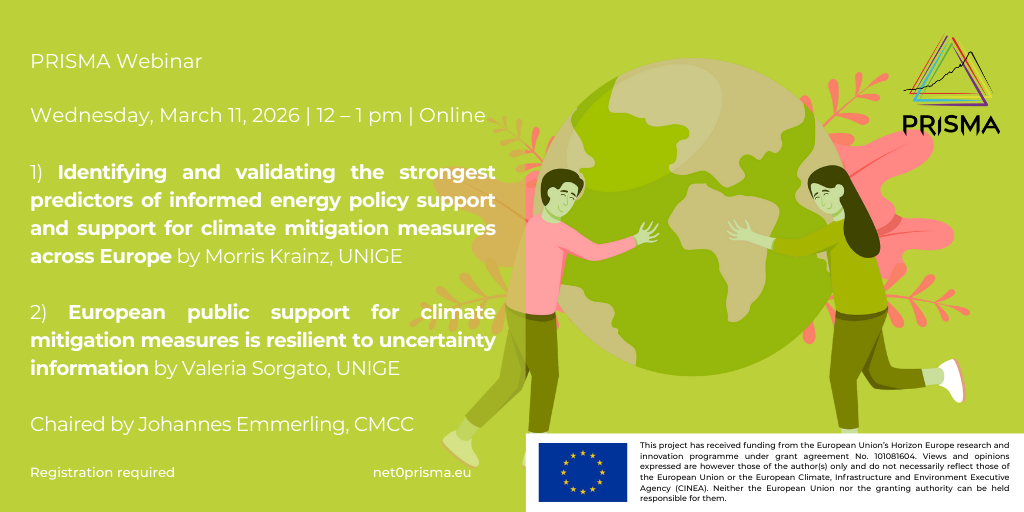
This PRISMA Webinar brings together cutting-edge research that sheds new light on these questions, drawing on large-scale empirical studies across Europe and innovative methodological approaches. Chaired by Johannes Emmerling (CMCC), the webinar will feature two presentations by researchers from the University of Geneva (UNIGE).
Presentantion 1: Identifying and validating the strongest predictors of informed energy policy support and support for climate mitigation measures across Europe
Speaker: Morris Krainz, UNIGE
Abstract: Widespread public policy support is crucial for efforts to decarbonize the energy system. Past research has proposed numerous variables as potential key predictors of support for mitigation policies but has failed to i) comprehensively evaluate and compare their predictive importance and ii) identify the strongest predictors within specific mitigation domains. We used machine learning models to identify the strongest predictors of energy policy support in informed citizens (Study 1), validate these results by forecasting the outcome of a real-world referendum on renewable energy in Switzerland (Study 2) and test their generalizability to public support for other climate mitigation measures across six European countries (Study 3). We identified affective responses, societal and environmental policy-impact beliefs, fairness perceptions and perceived trends in policy support over time as the strongest predictors of energy policy support. Using these predictors, we achieved high accuracy in predicting support for a real-world referendum as well as support for different climate mitigation measures across Europe.
***
Presentantion 2: European public support for climate mitigation measures is resilient to uncertainty information
Speaker: Valeria Sorgato, UNIGE
Abstract: Public acceptance is a critical factor for the successful implementation of climate mitigation measures. Yet, Integrated Assessment Models (IAMs) often exclude this social dimension, risking misjudging the real-world viability of the mitigation measures they are designed to model. This study explores how informed perceptions of feasibility-related uncertainties influence public acceptance, support, and affect towards four IAM-modelled measures: bioenergy with carbon capture and storage (BECCS), green hydrogen, afforestation/reforestation, and sustainable diets. In a survey across six European countries (Germany, France, Italy, Spain, Poland, and the Netherlands; total N = 3,351), we found that providing uncertainty information lowered acceptance, support, and, to a lesser degree, affect, but all measures remained positively evaluated, and differences between measures and countries remained stable. Sustainable diets and BECCS were least accepted, particularly in Poland and the Netherlands, where participants, on average, were opposed to sustainable diets. Higher perceived uncertainty, especially regarding social and technological feasibility, was negatively associated with acceptance and affect, an effect that strengthened after information, particularly for social uncertainty. Climate change beliefs emerged as the strongest predictor of acceptance among all predictive factors. Trust in scientists also contributed positively to acceptance of mitigation measures, while trust in government and sociodemographic variables showed marginal influence. Our findings underscore the importance of combining social factors with IAMs to better reflect real-world constraints and improve the design and communication of climate mitigation policies.
The webinar will conclude with a question and answer (Q&A) session.
Registration required: https://cmcc-it.zoom.us/webinar/register/WN_rodpPkkPTE-j4ARqNXDdCg
This project has received funding from the European Union’s Horizon Europe research and innovation programme under grant agreement No. 101081604 – PRISMA. Views and opinions expressed are however those of the author(s) only and do not necessarily reflect those of the European Union or the European Climate, Infrastructure and Environment Executive Agency (CINEA). Neither the European Union nor the granting authority can be held responsible for them.