

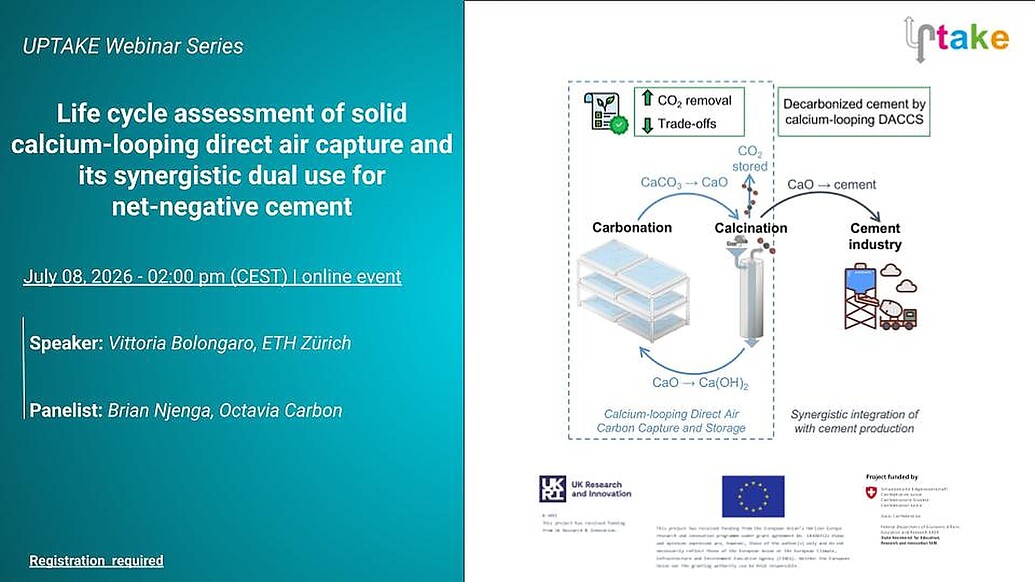
The next webinar on the latest published papers on carbon dioxide removal (CDR) research will focus on the paper Life cycle assessment of solid calcium-looping direct air capture and its synergistic dual use for net-negative cement
 Speaker: Vittoria Bolongaro, ETH Zürich
Panelist: Brian Njenga, Octavia Carbon
 8 July 2026, 2 pm – 3pm (CEST) I ZOOM, online
Register in advance  here.
here.
Abstract:
Calcium-looping direct air carbon capture and storage (DACCS) is a mature technology with potential for gigatonne-scale carbon dioxide removal (CDR), yet its environmental impacts remain insufficiently quantified. Here, we present the first prospective life cycle assessment of large-scale calcium-looping DACCS based on primary industrial data. Our results show high net CDR efficiencies of 85%–96% by 2050. Removing 1 Gt of CO2 would use less than 2.8% of the world’s safe operating space defined by the planetary boundaries. Hotspots, including particulate matter and water toxicity, mainly arise from the energy supply chain rather than the capture process. We also demonstrate promising synergies with cement production: cycling the calcium-based sorbent through the direct air capture (DAC) unit once before use as cement feedstock yields a carbon footprint of −0.15 tCO2-eq. per tonne of cement. These findings establish calcium-looping DACCS as both a competitive CDR pathway and a powerful tool for cement decarbonization.
The webinar format will consist of a 20-minute presentation and a 10-minute discussion with an invited expert stakeholder, followed by a 30-minute open discussion (1 hour total).