

EDGE (Energy Demand GEnerator) Buildings is a bottom-up model used to produce long-term building energy projections, with a 5-year temporal resolution, written in R. Initially developed at PIK (Levesque et al. 2019), it has been later adopted also at CMCC (Edelenbosch et al. 2021).
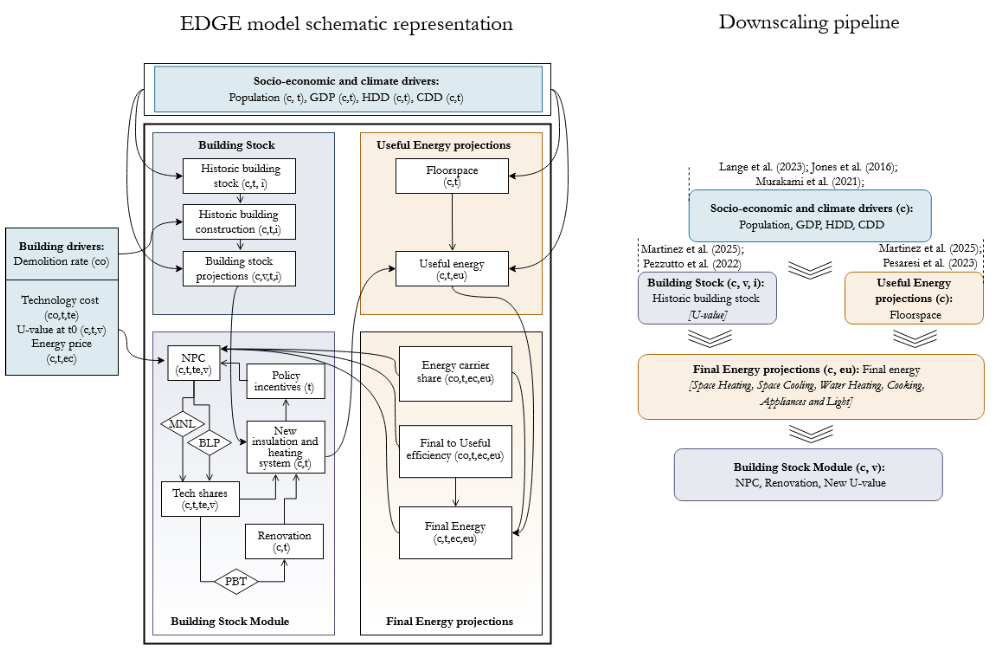
The model is designed to run up to 2100, it is multi-regional, and it has country-level and sub-national resolution only for Europe. It considers multiple energy carriers and end-uses, and it is partly statistically-based and partly optimization based within the Building Stock Module. More specifically, this Module represents the evolution of the building stock by considering construction, demolition, and renovation rates, by defining the optimal insulation levels for new and renovated building surfaces, and by selecting optimal heating systems technologies.
Space cooling energy demand is derived from a Random Forest model (Falchetta et al. 2024) which is endogenized within EDGE dynamics to represent the interplay between cooling and heating end uses and energy efficiency interventions.
Applications
Recent applications (Cofler et al. 2026) of the model have considered the modeling of energy efficiency policies for the EU building stock at sub-national resolution. Investment needs and public policy costs have also been estimated, including their spatial distribution, across scenarios ranging from a no-subsidy one to a Low Energy Demand scenario with restrictions on floorspace demand.
EDGE can be coupled with Integrated Assessment Models such as WITCH, and with energy system models such as MACRO and PyPSA.
Figure 1: on the left, a schematic representation of the EDGE model; on the right, the downscaling pipeline currently implemented to bring it at subnational resolution. The indices c, co, t, te, v, i, ec, eu, respectively, denote cell, country, time, technology, vintage, type of building (residential or commercial), energy carrier and end use. Blue boxes represent the inputs, dark purple boxes the modules for the building stock, the orange boxed the modules for energy.
Related publications:
O. Edelenbosch, D. Rovelli, A. Levesque, G. Marangoni, and M. Tavoni, ‘Long term, cross-country effects of buildings insulation policies’, Technological Forecasting and Social Change, vol. 170, p. 120887, Sep. 2021, doi: 10.1016/j.techfore.2021.120887.
- Levesque, R. C. Pietzcker, L. Baumstark, S. De Stercke, A. Grübler, and G. Luderer, ‘How much energy will buildings consume in 2100? A global perspective within a scenario framework’, Energy, vol. 148, pp. 514–527, Apr. 2018, doi: 10.1016/j.energy.2018.01.139.
- van Heerden et al., ‘Demand-side strategies enable rapid and deep cuts in buildings and transport emissions to 2050’, Nat Energy, vol. 10, no. 3, pp. 380–394, Mar. 2025, doi: 10.1038/s41560-025-01703-1.
- Falchetta, E. D. Cian, F. Pavanello, and I. S. Wing, ‘Inequalities in global residential cooling energy use to 2050’, Nat Commun, vol. 15, no. 1, p. 7874, Sep. 2024, doi: 10.1038/s41467-024-52028-8.
- Cofler, F. P. Colelli, G. Falchetta, and M. Tavoni, ‘Modeling policies for the EU building stock decarbonization at sub-national resolution’, Energy and Buildings, vol. 362, p. 117521, Jul. 2026, doi: 10.1016/j.enbuild.2026.117521.
Related publications:
[1] R. van Heerden et al., ‘Demand-side strategies enable rapid and deep cuts in buildings and transport emissions to 2050’, Nat Energy, vol. 10, no. 3, pp. 380–394, Mar. 2025, doi: 10.1038/s41560-025-01703-1.
[2] O. Edelenbosch, D. Rovelli, A. Levesque, G. Marangoni, and M. Tavoni, ‘Long term, cross-country effects of buildings insulation policies’, Technological Forecasting and Social Change, vol. 170, p. 120887, Sep. 2021, doi: 10.1016/j.techfore.2021.120887.
[3] A. Levesque, R. C. Pietzcker, L. Baumstark, S. De Stercke, A. Grübler, and G. Luderer, ‘How much energy will buildings consume in 2100? A global perspective within a scenario framework’, Energy, vol. 148, pp. 514–527, Apr. 2018, doi: 10.1016/j.energy.2018.01.139.
Tool Info
Scope
Energy sectoral model
