

TerraNova

TerraNova

A Foundation Model for the Anthropocene

TerraNova is a foundation model that learns a single representation of the physical Earth and of human societies, which are usually recorded in incompatible geometries: continuous gridded fields on one side, and indicators reported for administrative units on the other.
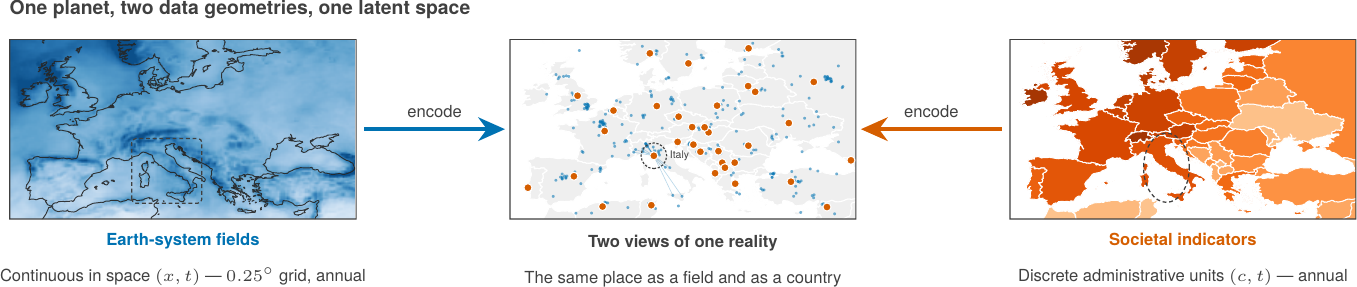

It is trained on 1,024 historical records in their native geometries: 512 gridded Earth-system fields from the WorldTensor dataset (0.25° grid, annual resolution) and 512 national indicators drawn from the Quality of Government dataset. Four dedicated encoders (location, country, time and task) feed a shared 256-dimensional spatiotemporal state. Two cross-modal transformers condition this state, and a hypernetwork generates a small decoder for each query. The decoder’s evidential head returns the parameters of a Normal–Inverse–Gamma distribution, yielding a predictive distribution with aleatoric and epistemic uncertainty proxies.


Tool Info
Scope

TerraNova is a foundation model that learns a single representation of the physical Earth and of human societies, which are usually recorded in incompatible geometries: continuous gridded fields on one side, and indicators reported for administrative units on the other.

Website

https://carlosrodriguezpardo.es/projects/TerraNova/

Mail Contact

carlos.rodriguez@cmcc.it